
By looking at this line and having your eyes comprehend the meaning of the shapes on the screen, you are continuing a tradition that started 5,000 years ago. It’s something that sets humans apart from any other species, and is part of the reason that we have been so technologically successful in the intervening millenia.
The tradition? Writing.
It’s literally everywhere. You don’t even have to think about it. Traffic signs, billboards, emails, texts, menus–if you challenged yourself to go a full day without reading a single word, you’d probably have to hide in a forest for the whole time. They don’t have toilet paper there.
In serious and society-changing ways, well-established thinkers, political scientists, philosophers, and researchers convey their ideas in books and papers and studies, not in drawings and videos. Graphics are designed to help a written point hit home, but never represent the entire analysis. Language is the main course; everything else is a side dish that your brother-in-law whipped up at the last minute.
Every collection of humans on the planet develops a spoken language; for some reason, spoken language is a deep part of who we are. That said, not all languages have writing systems. Writing is an effective method of communication. It’s efficient, it has many more possibilities than spoken language, but it’s still a weird thing that only some languages do. Thousands of spoken languages throughout human history have gotten by without it just fine.
So, needless to say, I am incredibly fascinated by writing.
If you were to DeLorean back in time to the first time anyone wrote anything down ever, you would probably find yourself in ancient Mesopotamia. Somewhere around 3,100 B.C.E., Mesopotamians started using a stylus on a wet clay tablet to keep lists in what’s called cuneiform script. They probably started out doing little pictograms and tallies so they could keep inventories, but over time it became a full-on way to record Mesopotamian languages. Also, it looks really cool.

One thing about cuneiform that is totally bananas is that it started with the Sumerian language. The Sumerians were a human civilization in the Middle East, and they developed cuneiform to write their own language, which was a “language isolate.” That means that the Sumerian language didn’t seem to come from any language we know of, and we’re not sure where it went, exactly, because it doesn’t seem to be related to anything. I guess you could call Sumerian the Cotton-Eyed Joe of languages.
Compare the language isolate Sumerian to the Akkadian language, a Semitic language what existed in the Middle East at the same time. Akkadian borrowed cuneiform from Sumerian, and over time Akkadian descended (sort of) into modern Middle Easern languages: Arabic, Hebrew, Amharic. When we’re confused about Akkadian, we could always use modern languages that share a common ancestor to make an educated guess about missing pieces; not so with Sumerian, even though they’re the ones that invented writing. That shit is B-A-N-A-N-A-S.
Anyway, Sumer and Akkadia did very well in the 3,000s B.C.E., partly because they were using writing. I mean, if you didn’t have writing, sentences like: “The King told the vizier to tell the guard to tell me to tell you that we’re goint to attack the enemy with our army on Thursday” would be impossible to interpret. This Thursday or next Thursday? If today is Wednesday, did the King mean to say ‘tomorrow?’ You’d have to go back to the high-stakes game of telephone, except they didn’t have telephones back then, so they didn’t have a name for the situation. I think that’s a tragedy.
Was everyone in Sumer/Akkadia literate? No. But among educated people, they didn’t need to keep someone with a good memory alive to hang around for information.
It is thought that Sumer and Akkadia were the ones who inspired the ancient Egyptians to start writing in their heiroglyphics; it’s also possible that Egypt spontaneously invented writing because they also thought it would be useful. In any case, around the same time, Egypt started writing themselves.

Hieroglyphs contained about 1,000 unique characters, and had some pretty loose rules that required a lot of studying–not nearly as easy as writing is today, but only the highly educated classes of society had to learn, anyway. As everyone knows, the Egyptians had a thriving society with architecture, medicine, politics, and agricultural achievements.
There are a lot of things that people still don’t understand about hieroglyphs because a lot of the knowledge was lost after ancient Egypt declined. However, some believe that they were partly written as an abjad, unlike cuneiform. An abjad is a writing system that writes consonants, but not vowels. Especially for Semitic languages, this makes a lot of sense, because they tend to use consonants and vowels in a particular way. Modern Semitic Languages tend to use a kind of abjad; Arabic script is a modified one.
T wld b dffclt t d ths wth nglsh, bt nt mpssbl t ndrstnd. (This is not a typo.)
Anyway, the Egyptians are minding their own business, hanging out, pyramids and such, when the Phoenecians swung by and thought that hieroglyphs were really cool, just waaay too complicated. The Phoenecians probably came from somewhere in the middle east, but their whole thing was sea travel; they ended up conquering a lot of the Mediterranean between 1,300 B.C.E and 1,200 B.C.E. They also spoke a Semitic language, so when they adapted the Egyptian writing system, they also made an abjad. It looked a little something like this:

It’s obviously far simpler than the hieroglyphs. It also completely removed pictograms from the writing, meaning that they stopped using picture-symbols for things (the Phoenecians never used a picture of an eye to say “eye”). No vowels, no pictures, just consonant-letters. And they did very well for themselves; so well that when the Greeks started looking to write their own language around 900 B.C.E., they decided Phoenecian would be a great place to start.
The Greeks didn’t, and don’t, speak a Semitic language, so they did need to keep vowels in their alphabet. They are also the source of the word “alphabet,” which is a compounding of the first two letters, “alpha” and “beta.” Now we use that word to talk about writing systems.
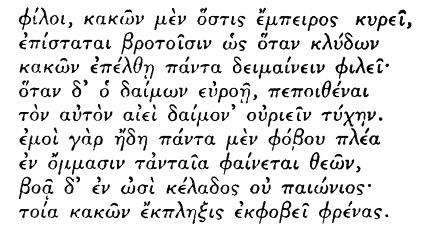
Naturally, the Greeks did all kinds of things in math, political science, and literature, so naturally we still talk about them all the time. They also gave us a weird combination between homosexuality and misogyny, which would be cute if a legacy of hating women weren’t still super abundant. But I digress.
The Greeks were very influential in the Mediterranean area, so they got all Christopher Columbus and decided they needed to colonize and spread their culture. Unlike Columbus, the Greeks did not slaughter people across the entire continent in droves. But they did have colonies outside of Greece; one of them was called Cumae, and it was in Italy. From Cumae, a modified version of the Greek alphabet spread; it is now called the Latin alphabet, and it is what I’m writing in now.
The Latin alphabet spread throughout Italy, and it was the writing system of the Roman Empire, which was also famously successful. Latin became a major language across Europe; once the Roman Empire collapsed, and people stopped talking to each other often, the language changed and evolved over time. The differentiated branches of Latin give us modern Spanish, Portuguese, French, Italian, and Romanian, among others.
One really interesting thing is that the Latin alphabet spread with religion; you used it if you were Catholic. If you were not Catholic, you usually used a different alphabet. For example, the Cyrillic alphabet (which is the one several Slavic languages like Russian use) was the preferred alphabet for orthodox speakers. Cyrillic is also related to all of the writing systems above, except it branched off from Greek sometime in the 9th century when the Slavic speakers of eastern Europe (including modern Ukraine and Russia) converted to Christianity. Here is an early version of the Cyrillic alphabet:

But Polish speakers, for example, were Catholic, so they use the Latin alphabet. Bulgarians, for their part, were orthodox, so they use Cyrillic. Croatians were Catholic, but Serbians were orthodox. Even though Croatian and Serbian are basically the same language, they write differently.
I mention religion and other writing systems partly to explain that there is always a reason why things fell together, and it can get tricky; Turkish, for example, uses Latin, but is a historically Muslim country. They stopped using the (Muslim-preferred) Arabic script after World War II as a part of the formation of modern Turkey from the Ottoman Empire. By contrast, Kazakh, a related language, went from using Arabic to using Cyrillic because modern Kazakhstan was a part of the Soviet Union. Anyway–my point is, there are lots more stories I’m glossing over here, because I’m focusing on English Latin.
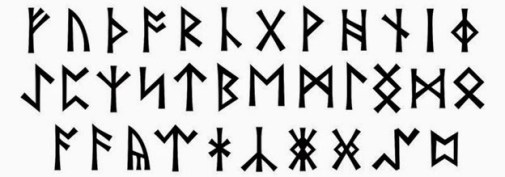
Catholicism is why English speakers use the Latin alphabet, so we English speakers are like the Poles and the Croatians. Before Christianity came to Britain, the Anglo-Saxons used a writing system called the futhorc, which they inherited from the Germanic tribes in central and northern Europe (side note: it’s likely that the Germanic tribes made the futhorc based on the Latin alphabet). An example of writing using the futhorc is below:
While the English were using the futhorc, the Irish were using Ogham, which was also probably based on the Latin alphabet.

The Irish were using Ogham until the Christian missionaries came in and brought with them the Latin script. Christianity spread through Ireland, and Irish missionaries brought Latin to the futhorc-using Anglo-Saxons, and pow! Now most of Europe uses Latin, us included.
In short–our writing system, this crazy way we put shapes in order to tell stories and convey ideas, has been 5,000 years in the making. It’s changed dozens of times throughout history–and it keeps changing today! Just take into consideration the way people use emojis to change the tone of their messages. “Okay 😔” does not have the same connotation as “okay 👍🏻”–and how would you convey that meaning otherwise? By adding “and I’m sad about it”? By clarifying “and by that I truly mean I’m onboard”?
No, writing has always been our tool to express ourselves, and the way we express ourselves will always be an added layer of context to what we’re saying. In short, writing has been a wild ride; let’s buckle down and enjoy where it continues to take us. From scribes impressing shapes on a clay tablet somewhere in the Middle East, to a sarcastic homosexual magically encoding letters onto a computer screen, the innovations of being human just won’t quit.
 from here to breakfast
Do you know anything about the development of Korean, Japanese, and Chinese? There’s apparently enough similarity between their writing that in one of my classes when a student doesn’t know a word in French, and there’s no one who speaks Korean/Japanese/Chinese to help them out, my teacher will have someone who speaks one of the other two languages write it out in their language and they’re usually able to figure it out. Love y’all.
LikeLike
Hello dear! Japanese and Korean are actually both based on Chinese characters, which is the oldest writing system currently in use in the world! Chinese characters started sometime in the 2nd or 3rd millenium BCE (!) with the “Oracle Bone Script.” It’s called that because inscriptions on bones are the primary way we know about it, and those bones were used for divination. Oracle Bone Script included a lot of logograms, meaning the written form of a word was just a picture of that word. Eventually these got more and more abstract and sloooooowly developed into modern Chinese characters, with lots of variants along the way. The People’s Republic of China reformed the Chinese writing system in the 50s and 60s, trying to make it simpler, and were mostly successful; Taiwan still uses the non-simplified script for political reasons.
The Japanese adapted the Chinese writing system into what was called Man’yōgana sometime between the 500s-800s. It’s kind of unclear when exactly, because the Chinese and Japanese were in communication, but Japanese people writing Chinese in Chinese doesn’t really count as the Japanese language having a writing system. Anyway, eventually they did adopt Chinese characters in a way that expressed the sounds of their language. Over time, these Man’yōgana characters were simplified into Hiragana and Katakana, two syllabaries (meaning one symbol stands for a whole syllable; “ta” and “to” are each one symbol in each syllabary). The kana were standardized in the 20th century, when people were really into doing that kind of thing. But Japanese kept Kanji, or Chinese characters that are not really changed, for certain substance words (verb stems, nouns, etc.), but now there is a nice healthy mix in written Japanese.
The Koreans adopted a slightly changed Chinese script called Hanja when Buddhism came to the Korean peninsula. The Koreans didn’t abandon Hanja fully until the 19th-20th centuries, so if you’re looking to read older Korean texts, you better dig into that old Chinese! The move away from Hanja was to a script called Hangul, which was actually invented in the 15th century by Sejong the Great, but hadn’t gotten its chance to shine yet. Hangul is totally interesting because it is kind of an alphabet, but it stacks the “letters” into a syllabary. Wikipedia (the source for many of my rants) has the very helpful example of the word for “honeybee” being written 꿀벌, not ㄲㅜㄹㅂㅓㄹ. It was actually designed to be easy so that literacy could spread.
Anyway, I didn’t include these because I was specifically looking at English’s writing system and how we got here. Sorry there isn’t as much detail – I am not as familiar with these ones!
– Mike
LikeLiked by 1 person